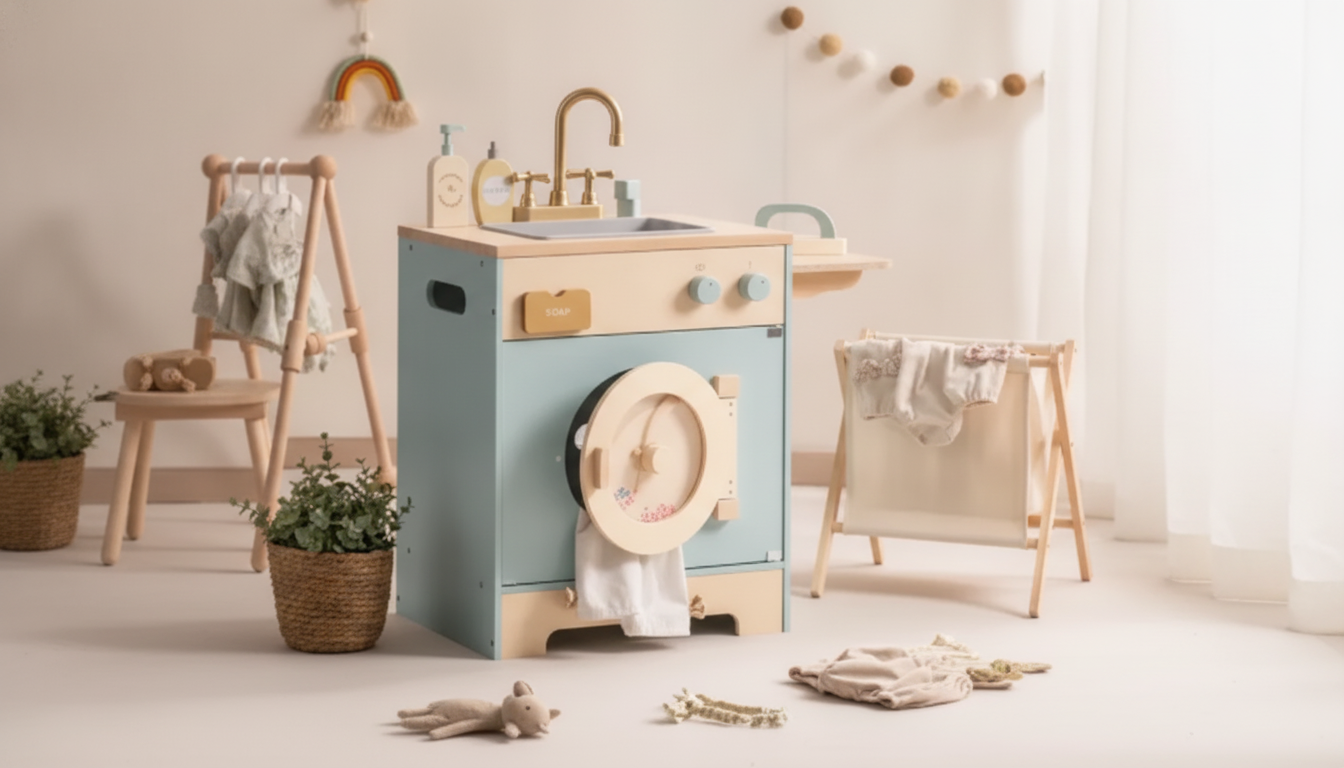
A wooden kitchen washer playset with a sink and accessories turns everyday routines into imaginative, skill-building play. With room for pretend washing, rinsing, and organizing, it supports creative role-play while encouraging practical habits like sorting and tidying—without needing batteries or screen time. The best part is how naturally it fits into a child’s world: it’s not “practice,” it’s play that just happens to mirror real life.
What This Playset Includes
This style of set blends kitchen-themed role-play with a wash station vibe, giving kids a single “home base” for cooking, serving, and cleaning storylines.
- Wooden play kitchen unit with an integrated sink area and washer-style role-play features
- Accessory set designed for realistic “wash and rinse” scenarios (e.g., pretend dishes/utensils and cleaning-themed pieces)
- Kid-friendly scale that fits well in bedrooms, playrooms, or living areas without dominating the space
- Sturdy wood construction intended for repeated, energetic pretend play
If you’re shopping for a ready-to-go setup, the Wooden Kitchen Washer Playset with Sink and Accessories keeps the focus on hands-on routines—rinse, scrub, dry, and “put away”—with a classic wooden look that blends easily into most home spaces.
Why Kids Keep Coming Back to Wash-and-Prep Play
Wash-and-prep play is one of those surprisingly “sticky” activities: kids return to it because it can change roles, rules, and stories every time.
- Open-ended storytelling: meals, cafe games, family routines, and “restaurant cleanup” can all happen in one station
- Cause-and-effect exploration: turning knobs, placing items in the washer area, and moving accessories from “dirty” to “clean” builds simple sequencing
- Confidence through imitation: children often enjoy copying grown-up tasks in a safe, playful format
- Cooperative play: siblings or friends can split roles (cook, washer, server), practicing turn-taking and sharing
Many kids especially love the “transition” moments—moving items from sink to drying area, sorting utensils, and declaring something “sparkly clean.” Those little rituals make the play feel complete, not random.
Skills It Can Support During Everyday Play
A sink-and-washer station can quietly support multiple developmental skills because it naturally invites repeated motions, short scripts, and simple organizing challenges.
- Fine-motor practice through grasping accessories, placing items in and out of the sink area, and manipulating play controls
- Language development through role-play dialogue (ordering food, naming utensils, describing steps like rinse/scrub/dry)
- Early math concepts like sorting by type, counting items, and organizing “before/after” sets
- Social-emotional growth by practicing helpfulness, responsibility themes, and gentle caregiving routines
For families who like low-pressure learning, this kind of pretend play is a practical choice: the skills show up as part of the story, not as a “lesson.”
Materials, Finish, and Everyday Durability
Wooden playsets are popular for a reason: they tend to feel stable under enthusiastic play, and they hold up well when kids repeat the same routines again and again.
- Wooden builds typically offer a stable feel and long-term play value compared with lightweight plastic sets
- Look for smooth edges, well-seated hardware, and a finish that wipes clean easily
- For busy households, regular quick checks help keep screws tight and surfaces splinter-free
- Place on a flat surface to reduce wobble and keep play consistent
Quick Safety & Care Checklist
| What to check |
Why it matters |
Simple habit |
| Smooth edges and corners |
Reduces scrapes during active play |
Run a hand around edges monthly |
| Accessory size and condition |
Helps prevent breakage or small-part issues |
Remove damaged pieces promptly |
| Stable placement |
Prevents tipping during pretend “scrubbing” |
Use on level flooring; avoid cluttered corners |
| Surface cleanability |
Keeps play hygienic after frequent handling |
Wipe with a damp cloth; dry thoroughly |
For broader toy safety guidance, the American Academy of Pediatrics toy safety overview and the U.S. Consumer Product Safety Commission toy safety resources are helpful references when evaluating toys for your home.
Setting Up a Play “Wash Station” That Stays Organized
A little structure can make cleanup feel like part of the fun (instead of a hard stop). These small setup tweaks also make it easier for kids to jump into independent play.
- Designate a small basket for accessories so cleanup feels like part of the game
- Add a simple routine: “cook → serve → wash → dry → put away” to encourage sequencing
- Rotate a few accessories weekly to refresh play without adding clutter
- Pair with play food or a small menu board to expand scenarios beyond washing alone
Who It’s Best For
Product Snapshot and Buying Notes
At-a-Glance Details
Another Hands-On Gift Option (Different Age/Interest)
If you’re also shopping for an older sibling who prefers building and tinkering over pretend play, the ArmPi FPV AI Vision Robotic Arm Python & ROS Powered is a more advanced, maker-style alternative—best suited for supervised use and robotics-focused households.
FAQ
Is a wooden sink-and-washer playset easy to clean?
Yes—most wooden playsets clean up well with a damp cloth and mild soap as needed. Avoid soaking the wood, and dry thoroughly so the finish stays in good shape.
What age range is this type of playset usually suitable for?
Many pretend kitchen and wash-station sets are designed for preschool through early elementary ages. Always check the specific product’s age recommendation and any small-parts warnings before purchasing.
How can this playset encourage independent play?
Set up a simple repeatable “script” (wash → rinse → dry → put away) and store accessories in one easy-to-reach bin. When kids can start and finish the routine on their own, they’re more likely to keep the play going without constant adult direction.
Recommended for you









Leave a comment